
Haemia Melling
on the good mahi model
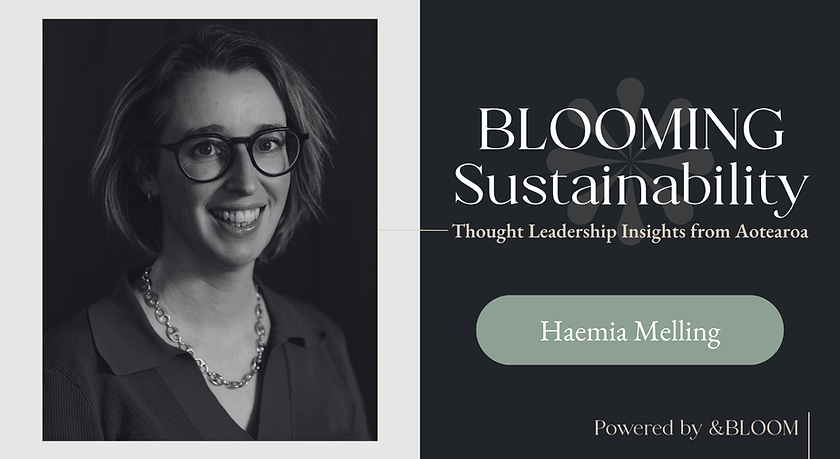
For Haemia Melling, sustainability is a living, breathing practice—much like the harakeke that thrives across Aotearoa. Tender shoots at the centre are protected by outer leaves, just as people and communities protect nature and one another. “The fibres on their own are fragile,” she reflects, “but woven together they become strong and enduring.” That weaving of people, planet, and purpose is what nurtures sustainability in her life—and in the work she leads through Impact Ink, the organisation she founded to create meaningful impact across businesses and not-for-profits.
In the early days, Haemia knew two things: she wanted to work alongside organisations of all kinds, and she wanted her pricing to fairly reflect the capacity and constraints of not-for-profits. The result was the Good Mahi Model, a structure designed to redistribute value, amplify impact, and allow participants to share the story of their ripple effect of good. “It’s about creating the conditions where everyone can contribute and be acknowledged,” she says.
Haemia’s journey was shaped by discovering her “common thread”: a consistent drive to create equity for people and communities. From financial education to addressing human rights risks and driving social sustainability, her work has always focused on making things better for people. “I thrive on mahi that makes a difference,” she says, “and understanding what inequity looks like in Aotearoa is central to that.”
Yet challenges remain. Many organisations overemphasise environmental sustainability, neglecting social and governance factors, while “green-hushing” keeps meaningful stories from being shared. Haemia’s mantra is simple: “Tell the damn story. It’s not about you - it’s about the impact on people, planet, and prosperity.”
Her approach to stakeholder engagement is rooted in whakawhanaungatanga. Relationships form the foundation for trust, challenge, and purpose-driven conversations. By understanding a business’ “why,” Haemia helps organisations align purpose with impact. She also draws inspiration from Te Whare Tapa Whā, the Māori health model illustrating the interconnection of wellbeing, community, and environment.
Haemia’s advice to rising changemakers? “Identify your common thread and name your strengths. Use those words to act with purpose.” She champions collaboration with experts who bring data and heart together. And her vision for Aotearoa’s superpower in sustainability is clear: leaning into the deep, enduring knowledge of tangata whenua, while sharing that wisdom responsibly.
One seed of change she hopes to plant: “There’s kindness in sharing. Share your knowledge, resources, and stories of impact. That’s how we influence for good.”
BLOOMING Sustainability Questionnaire
Name: Haemia Melling
Company & Title: Impact Ink, Founder and Director
Website & LinkedIn Profile: www.impactink.co.nz , www.linkedin.com/in/haemia
* Guiding Values | Kaupapa
If sustainability were a flower blooming in your life, what would it look like? What nurtures it?
Fun! Let me get a bit poetic here, eh? Sustainability as it features in my life, is like harakeke. Over time it has adapted and now belongs uniquely to Aotearoa. The tender new shoot at the centre is sheltered by the outer leaves, just as people and communities protect nature and one another. Harakeke, as a material for weaving with illustrates that fibres by themselves are fragile, but when woven together become strong and enduring. What nurtures sustainability in my life is connection, protection, and the weaving of people, planet, and purpose together.
A quote, personal motto or whakataukī that reflects your vision:
This is an inherited understanding from Mum: Words are important because words lead to action (good, bad, and ugly).
If you could mentor a rising change-maker in Aotearoa, what advice would you share?
If you’re not sure where you’re headed, identify a ‘common thread’ in the experiences or work you’ve found meaningful. It will help you articulate what brings you joy, and in turn, what you should hone in on and develop further.
Complimentary to that is to find your strengths vocabulary. Name what it is that you do well, and what it is that you need people around you to be good at.
* Leading Change | Arataki
A key moment in your journey that shaped your path:
A couple of years ago, while updating my CV and considering my next career move, I had a pivotal moment. I had discovered my “common thread.” Reflecting on the diverse mahi I had done, different in practice but connected in purpose, I realised:
I thrive on mahi that creates greater equity for people and communities
whether through teaching, financial education, addressing modern slavery and human rights risks, or driving social sustainability and community investment, the focus was always on making things better for people, which required understanding what inequity looks like in Aotearoa.
What’s the main challenge you face in driving sustainability within your sector?
What I’ve observed is that generally there are two key challenges:
Many organisations focus on environmental sustainability, which is critical, but often under-invest in the social (S) and governance (G) parts of ESG. Without all three, there’s a mismatch that can create unintended consequences. And part of that could be because they’re overthinking what that might mean in their business, or they’re neglecting connecting it to their purpose.
We also have a habit of “green-hushing” (or “ESG-hushing”). Organisations may be doing good mahi but they stay silent. This drives me batty. This lack of narrative (data-informed and heart-led) has a bloody negative outcome: If you don’t share your impact, how can others learn from you or be inspired? Simply put: tell the damn story because it’s not about you. It’s about the impact on people, planet, and prosperity.
An area you need more support with:
I love having more environmental genius’ in my corner. I’m no ‘scientician’ so I need people who know the science but who can also speak my language (with narrative balanced with a dash of optimistic scepticism). I want more environmental storytellers to show us how to connect the data with heart.
An Indigenous perspective you admire and want people to be mindful of:
Through my experience in education, I was exposed to the concept of Te Whare Tapa Whā (a Māori health model developed by Sir Mason Drury in the 80s). This is a simple framing of the connectedness of things. Te Whare Tapa Whā relates to the hauora | health and wellbeing of a person through the imagery of a whare | house. When one aspect of the whare is under pressure, it places pressure on the other parts. The model also includes our connection to whenua | ‘foundations’. When whenua is under pressure, it has influence on the other taha | sections of the structure of our humanity. In sustainability this is something practitioners may innately understand. For those organisations and people exploring what ESG is, I think this illustration can help us articulate where opportunities lie for positive impact.
Your best approach for engaging stakeholders in meaningful dialogue about ESG:
Whakawhanaungatanga. Relationships are at the heart of having a trust-based, challenge-filled kōrero. And these words shared can lead to a solid conversation that asks why. To understand a person and a business’ ‘why’ is to be able to help them link purposefully to ESG. For example, if the reason a business sponsors a sports club is because it’s ‘always done it’, so what? What’s the purpose? If that business told me they want to be good for the community where they operate, does that community need money spent on a sports team, or is that community screaming out for a different type of support? The art (heart) of whakawhanaungatanga allows you to ask ‘so what’ without threat but with warm wero | challenge.
What do you think is Aotearoa’s superpower in creating a sustainable future?
It’s leaning towards the deep and lasting knowledge of tangata whenua. Sustainability (the interconnectedness of the environmental, the social, and the governance) just is in te ao Māori. But this should be prefaced with an acknowledgement of the cultural tax that’s put on tangata whenua when tangata tiriti and pākeha come knocking on the door asking to learn.
* Surfing the Green Wave | Kakariki
Books, podcasts, courses or other resources that profoundly shaped your approach to sustainability:
This may seem a loosely related course, but when I was at the University of Auckland, doing my English and Drama degree to become the teacher I was always going to be (smirk), there was one paper in my Bachelor of Arts that profoundly shaped my connection with those who haven’t lived like I have: The paper was called Global Literature.
This was a paper that allowed us first year students to be exposed to writers of colonised nations. And what a heck of an education that was. I read Salman Rushdie, Chimamanda Ngozi Adichie (Purple Hibiscus my most recommended book), Arundhati Roy, to name a few. This is where, as a young woman learning to be a grown up, I think I really began to start to consider the profound and generationally-lasting impacts of colonisation on nations of people, and then connecting that thinking to being within the context of Aotearoa: what colonisation may mean for tangata whenua.
School didn’t teach me that.
Events in Aotearoa or globally that you think are must-attend:
The “event” that is a volunteer day with your mahi-team. Volunteering is actually a chance to be selfish but feel like you’re being altruistic. You often benefit intensely from volunteering. My favourites were the annual Mahurangi River rubbish hunts I used to go on when I worked with my Westpac Warkworth team. It was gross, dirty, confronting, and it was enlightening, connecting you to the impacts of a dumb decision (“it’s just one single piece of rubbish” landing right next to other “single pieces of rubbish” ), and it was a shared experience with people whose company I liked – work pals.
A sustainable initiative or project in Aotearoa that deserves more attention:
Can I call out my own Good Mahi Model™ here? Too often, businesses give generously but without purpose or structure. The model connects a portion of revenue to social or environmental intiatives.
It’s a simple way to price for purpose and understand the impacts of your purpose (so you can tell the damn story!)
If your work could plant one seed of change for the future, what would it be? As I remind my tamariki daily (multiple mother flippin’ times): “There’s kindness in sharing.” Share your knowledge, your resources, your stories of kindness. That’s how we influence for good.
The leader(s) you endorse for a future edition of Blooming Sustainability: Belinda van Eyndhoven, Head of Sustainability at Westpac New Zealand. She’s a force. She’s a quiet achiever for good and she deserves more recognition as a powerhouse of change.
* One actionable takeaway for our readers to make a change today for a brighter tomorrow:
Name your strengths. Then use those words to act with purpose.


